Our Contacts
  • Niejia village, Liushu town Laobian district,
    Yingkou,China
  • +86 417 3893911
Induction Bending

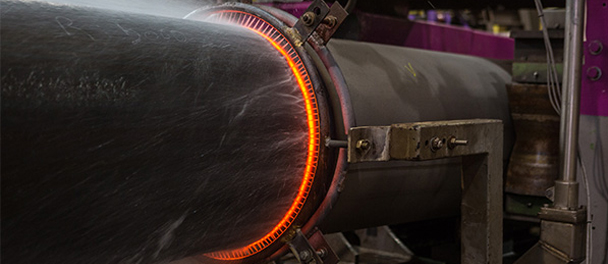
Induction Bending is a controlled means of bending pipes through the application of local heating using high frequency induced electrical power. It is a largely automated, free forming process. The necessary heat for bending is induced in a narrow circumferential band by means of an induction coil, which advances con- tinuously along the length of the pipe during bend forming operation.
Cold bending is also known as roll bending because of the process most commonly used to bend metal that hasn't been heated. Roll bending is accomplished using a mechanical jig that uses three rollers to bend metal into a circular arc. Avoids the need for components with an elbow, allowing cheaper, more readily available straight materials to be utilised. A stronger end product than elbows with a uniform wall thickness. Large radius bend capability reduces friction and wear.

INDUCTION BENDING

The Elbow is made by means of intermediate frequency heating and the elbow pushing machine is used to make an elbow that meets the curvature radius required by the customer, usually 2.5D-10D

Here's a general overview of the hot induction bending process:
  • Pipe Preparation: The straight pipe section is prepared by removing any coatings, such as paint or insulation, that may interfere with the bending process.
  • Heating: An induction coil is wrapped around the pipe at the desired bending location. The coil generates a high-frequency electromagnetic field, which induces electrical currents within the pipe, causing it to heat up rapidly. The pipe is typically heated to a temperature above its recrystallization temperature but below its melting point.
  • Bending: Once the pipe reaches the desired temperature, it is transferred to a bending machine. The bending machine consists of a fixed radius die and a movable arm. The heated pipe is placed on the die, and hydraulic or mechanical forces are applied to the pipe to bend it around the die to the desired angle. The bending process requires careful control of pressure and speed to ensure a smooth and accurate bend without causing any deformations or wrinkles in the pipe.
  • Cooling: After the pipe has been bent to the desired angle, it is allowed to cool slowly to room temperature. This cooling process helps to relieve any residual stresses that may have developed during the bending operation.
Hot induction bending offers several advantages over other bending methods, such as cold bending or field bending. It allows for greater flexibility in creating complex curved sections with tight radii while maintaining the structural integrity of the pipe. The controlled heating and bending process also minimizes the risk of material fractures or defects. Hot induction bending is commonly used in industries such as oil and gas, petrochemical, and power generation, where pipelines need to navigate obstacles or follow specific route configurations.